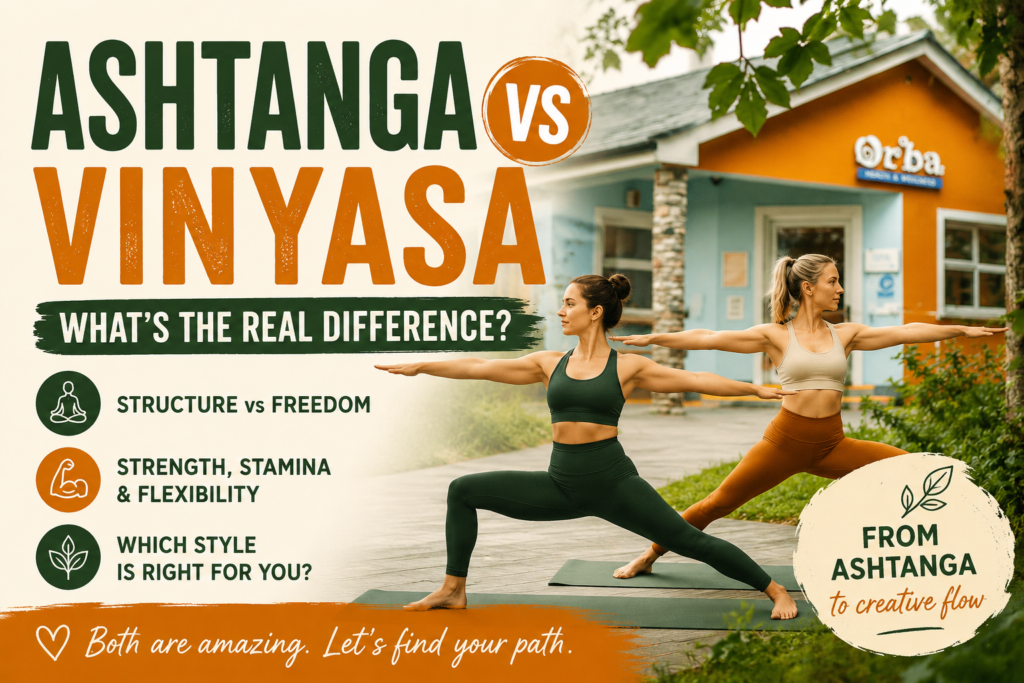
Every year I get new students walking into the studio in Omagh who’ve been doing yoga at home for months through apps and YouTube, and they ask the same question: “Ashtanga vs Vinyasa, what’s the actual difference?” It’s a fair question because the two look similar on the outside and most online guides make them sound interchangeable. They’re not.
After 20 years of teaching both styles, I can give you the honest picture: the real difference between Ashtanga and Vinyasa, which one suits which personality, which builds what, and whether you need to pick at all.
Table of Contents
Ashtanga vs Vinyasa: The Key Differences
Here’s the side-by-side answer to “difference between Ashtanga and Vinyasa” in one table:
| Element | Ashtanga | Vinyasa |
|---|---|---|
| Sequence | Fixed: same postures every time | Variable: teacher designs each class |
| Origin | Pattabhi Jois, Mysore, 20th century | Western evolution of Ashtanga, 1980s to 90s |
| Traditional setting | Mysore-style (self-led) or Led | Teacher-led studio class |
| Length | 90 min to 2 hrs (full primary) | 45 to 75 min typically |
| Breath | Ujjayi throughout, breath-count precise | Ujjayi, looser count |
| Focal tools | Tristhana (breath, drishti, bandha) | Creative sequencing, peak postures |
| Music | None: silent except breath | Common: often curated playlists |
| Predictability | Total: you know what’s next | Low: every class different |
| Community culture | Serious, traditional, committed | Friendly, accessible, studio-based |
| Progression | Teacher gives next posture when ready | Self-directed through class levels |
The simplest summary: Ashtanga is the original recipe; Vinyasa is the variations.
The Core Difference Between Ashtanga and Vinyasa
If someone asks you to explain the difference between Ashtanga and Vinyasa in one sentence, it’s this: Ashtanga gives you the same sequence every time and trusts that repetition creates depth. Vinyasa gives the teacher creative freedom and trusts that variety keeps you engaged. Everything else, the breath work, the physical challenge, the mental focus, is shared DNA.
What Is Ashtanga Vinyasa Yoga?
Ashtanga Vinyasa Yoga was systematised by Sri K. Pattabhi Jois in Mysore, India, in the 20th century, drawing on teachings from his teacher Tirumalai Krishnamacharya. The word “ashtanga” means “eight limbs” in Sanskrit, a reference to the eightfold path outlined in Patanjali’s Yoga Sutras. Despite the name, most modern Ashtanga practice focuses heavily on asana (physical postures).
The structure
Ashtanga is built around six fixed series of postures, practised in order:
- Primary series (Yoga Chikitsa): yoga therapy, the standard starting point
- Intermediate series (Nadi Shodhana): nerve cleansing
- Advanced series A, B, C, D: for long-term dedicated practitioners
Most practitioners work only with the primary series for years. Some never move beyond it. The first series alone takes 75 to 90 minutes and includes standing postures, seated forward bends, twists, backbends, inversions, and a closing sequence.
Tristhana: the three focal points
The heart of Ashtanga practice is tristhana: three simultaneous focal points maintained throughout every posture.
- Breath: ujjayi (victorious) breath, audible, smooth, controlled
- Drishti: a specific gaze point for every posture
- Bandha: internal “locks” (muscular engagements at the pelvic floor, lower abdomen, and throat)
This triple focus is what makes Ashtanga meditative in motion. Once you’re in it, the outside world genuinely falls away.
See the K. Pattabhi Jois Ashtanga Yoga Institute for the lineage’s authoritative teachings.
Mysore-style vs Led class
Traditionally, Ashtanga Vinyasa Yoga is taught in two formats: Mysore-style (you practise the series at your own pace while the teacher moves around giving adjustments) and Led class (the teacher calls each count in Sanskrit and everyone moves together). Mysore is the deeper format. Led is where most newcomers start.
What Is Vinyasa Yoga?
Vinyasa is the creative, modern offspring of Ashtanga. Western teachers in the 1980s and 1990s who trained in Ashtanga started designing their own sequences using the same breath-to-movement foundation but with the freedom to vary postures, pace, and peak poses. The result is what most people today call “flow yoga.”
The structure
No fixed series. Every Vinyasa class is designed by the teacher. Some follow a peak-pose arc (warming up, building to one challenging posture, cooling down), some follow a theme (hip openers, heart openers, core), and some simply flow through the teacher’s creative sequencing of the day.
Despite the variety, most Vinyasa classes share certain elements:
- Opening centring + intention
- Sun salutations (surya namaskar A and B) as a warm-up
- Standing sequence building heat
- Peak posture or arc
- Cooling postures (hip openers, forward folds, twists)
- Savasana
The breath-movement link
The word “vinyasa” literally means “to place in a special way,” and in practice refers to linking each movement to a specific inhale or exhale. Inhale rises and opens. Exhale folds and twists. This breath-linked movement is the core mechanism both Ashtanga and Vinyasa share.
For more on the different yoga styles and where Vinyasa sits among them, see my guide to types of yoga.
Ashtanga vs Vinyasa: Structure Comparison
The structural contrast is the cleanest way to understand what each style offers day-to-day.
| Aspect | Ashtanga (primary series) | Vinyasa (typical class) |
|---|---|---|
| Opening | Opening mantra | Centring, intention, theme |
| Warm-up | 5 Surya A + 5 Surya B | 3 to 5 Surya A, maybe 2 to 3 Surya B |
| Standing | Fixed standing sequence | Teacher’s designed flow |
| Seated | Fixed seated sequence | Variable |
| Peak | Baddha Konasana + Upavistha | Whatever the teacher builds to |
| Finishing | Fixed finishing sequence | Variable: often hip openers + twists |
| Savasana | Mandatory, strict silence | Mandatory, often with music |
| Closing mantra | Yes | Rarely |
The predictability of Ashtanga is either deeply appealing or deeply boring depending on your personality. Some people find the repetition meditative and transformative. Others find it maddening.
Ashtanga vs Vinyasa: Which Is Harder?
Honest answer: Ashtanga primary series is harder than most Vinyasa classes, but not for the reason most people think.
It’s not the postures. Vinyasa can use every posture Ashtanga uses. What makes Ashtanga physically harder is the volume and the repetition. A full primary is 75 minutes of continuous flow with no breaks, every day, six days a week (traditionally with Saturday rest plus moon days). Most Vinyasa practitioners take 1 to 2 rest days a week.
What makes Vinyasa potentially harder
A well-designed Vinyasa class can genuinely exceed a primary series in intensity: longer holds, more creative arm balances, tougher peak postures. I’ve taught 75-minute Vinyasa sessions that pushed students harder than any Ashtanga class they’d done.
“I thought Vinyasa would be the ‘easier’ option after four years of Ashtanga. Then I tried a proper power Vinyasa class in Belfast and I was completely wrecked. I realised the difficulty depends on the teacher, not just the style.”
Conor, Omagh (student since 2019)
Ashtanga vs Vinyasa for Beginners
For a true beginner, start with Vinyasa, but only after a few Hatha classes to learn the foundational postures.
Why Vinyasa first
- Teacher is calling every cue in real time so you can’t get lost
- Teacher builds in modifications for every level
- Pace is slower and gentler than a full primary series
- More community-friendly culture for first-timers
- Easier to drop in and try without commitment
Why Ashtanga might work for some beginners
- If you love structure and hate not knowing what’s next
- If you prefer solo practice to teacher-led flow
- If you already have a serious fitness or martial arts background
- If discipline is your personality
If you’re in Northern Ireland and want to start with either style, read my yoga for beginners guide first, then come along to a class. Our Omagh studio teaches Vinyasa three times a week.
Ashtanga vs Vinyasa for Flexibility
Both styles build flexibility, but they arrive at it differently.
Ashtanga builds flexibility through repetition. Because you practise the same postures every day, you develop deep, predictable openings in specific ranges: hamstrings, hips, shoulders, spine. Long-term Ashtangis often have extraordinary range in these areas.
Vinyasa builds flexibility through variety. Different classes target different tissues each time, which gives you a broader (but sometimes less deep) range of mobility. Vinyasa is often better for functional, real-world flexibility.
If your specific goal is extreme flexibility (think full splits, deep backbends, advanced arm balances), Ashtanga typically wins long-term. If your goal is balanced, useful flexibility for everyday life, Vinyasa is enough. Either way, don’t expect results in weeks. Meaningful flexibility changes take months of consistent practice, regardless of which style you choose. The biggest mistake I see is students switching styles every few weeks looking for faster results instead of committing to one approach long enough to see progress.
Ashtanga vs Vinyasa for Weight Loss
Neither is a magic weight-loss tool, but both burn significant calories.
| Practice | Calories per hour (70kg adult) |
|---|---|
| Gentle Hatha | ~230 |
| Power Vinyasa | ~400 to 550 |
| Ashtanga (primary series) | ~450 to 600 |
| Hot Vinyasa | ~500 to 700 |
Ashtanga edges Vinyasa slightly for pure calorie burn because of its unbroken intensity. But the more important factor for weight loss is consistency, and Vinyasa’s variety often makes it easier to stay consistent long-term.
For a broader comparison of yoga approaches for weight loss, see yoga for weight loss, and for the perennial debate with Pilates, see yoga vs Pilates. The Yoga Journal and Yoga Alliance both have helpful style guides if you want to compare further.
Can You Practise Both Ashtanga and Vinyasa?
Absolutely, and many serious practitioners do. The two practices reinforce each other.
A sensible weekly combination:
- 3 Ashtanga sessions: Mon/Wed/Fri morning primary series
- 2 Vinyasa classes: Tue/Sat evening, teacher-led for creativity
- 1 Yin or Restorative: Sun, to balance the intensity
- 1 rest day: non-negotiable
This structure gives you the discipline and depth of Ashtanga plus the variety and community of Vinyasa. Most students I know who’ve practised for 10+ years have drifted into some version of this blend. Fionnuala, a long-standing student who drives in from Enniskillen, has done exactly this rotation for six years. She says it’s the only routine she’s managed to hold onto through two kids and a demanding career.
The key is to let each style serve its purpose. Use Ashtanga mornings for the meditative, inward focus that comes from repetition. Use Vinyasa evenings for the creativity and social energy of a group class. Over time you’ll naturally feel which balance works for your body and schedule. There’s no rule that says you have to commit to one or the other permanently.
FAQs: Ashtanga vs Vinyasa
Is Ashtanga harder than Vinyasa?
Generally yes. A full Ashtanga primary series is longer, more intense, and more repetitive than most Vinyasa classes. But a well-designed power Vinyasa class can exceed Ashtanga in intensity. Difficulty depends on the teacher and intention more than the label.
Is Ashtanga a type of Vinyasa?
Technically the reverse. Vinyasa evolved out of Ashtanga. Ashtanga’s full name is “Ashtanga Vinyasa Yoga.” Modern Western Vinyasa kept the breath-to-movement foundation but dropped the fixed sequence, making it flexible and creative.
Can I start Ashtanga as a complete beginner?
Yes, but with the right approach. Start with Led Ashtanga classes (not Mysore-style) and expect to feel lost for several weeks. Many teachers recommend 3 to 6 months of Hatha or beginner Vinyasa first, so you know the foundational postures.
Which is better for anxiety, Ashtanga or Vinyasa?
Either works. Both use ujjayi breath and movement to calm the nervous system. Ashtanga’s repetition is deeply meditative once you know it. Vinyasa’s creativity is engaging for busy minds. Choose based on personality.
Do you need to be flexible to start Vinyasa?
No. Flexibility is a result, not a prerequisite. Vinyasa teachers offer modifications for every pose. Beginners with zero flexibility can start and progress quickly with consistent practice.
Why is Ashtanga practised six days a week?
Traditional Ashtanga practice is daily (six days, with Saturday rest plus moon days) because the repetition is the mechanism. Daily practice deepens each posture over months and years. Most modern practitioners adapt this to 3 to 5 days a week.
What’s the difference between power yoga and Vinyasa?
Power yoga is essentially a strength-focused sub-genre of Vinyasa: faster, sweatier, more fitness-oriented. Traditional Vinyasa includes more variety of tempo and intensity. Bryan Kest and Baron Baptiste are the best-known power yoga lineages.
Ashtanga Yoga vs Vinyasa Flow: does it matter which you pick?
Not as much as the internet wants you to think. The Ashtanga yoga vs Vinyasa flow choice matters less than finding a qualified teacher and showing up consistently. If you thrive on routine, lean Ashtanga. If you get bored easily, lean Vinyasa. Most long-term practitioners end up doing both.
Should I choose Ashtanga or Vinyasa for my first class?
For your very first yoga class, Vinyasa is usually the better starting point. The teacher guides every movement in real time, so you won’t feel lost. Once you’re comfortable with the foundational postures and breathing, trying an Ashtanga Led class is a natural next step. Choosing Ashtanga or Vinyasa as a beginner is less about the “right” style and more about which class environment feels comfortable enough that you’ll come back next week.
Can Ashtanga or Vinyasa damage your body?
Like any physical practice, yes, if done without attention. Ashtanga’s repetition can cause repetitive strain if alignment is poor. Vinyasa’s variety can cause confusion for beginners who rush through transitions. Work with a qualified teacher, listen to your body, and neither style should harm you.
The Bottom Line
The Ashtanga vs Vinyasa question is less about right and wrong than about temperament.
If you want structure, discipline, and the deep meditative effect of doing the same thing with total focus, choose Ashtanga. If you want creativity, variety, and a practice that meets you fresh each week, choose Vinyasa. If you want both benefits, do both. Most serious long-term practitioners eventually do.
The Ashtanga yoga vs Vinyasa flow debate has been running for decades online, and it usually misses the point. Both styles share the same root: breath linked to movement, ujjayi breathing, sun salutations as the engine. The difference is in how much freedom the teacher and student have within that framework. Ashtanga says “follow the series.” Vinyasa says “use the tools however you like.” Neither answer is wrong.
What matters most isn’t the style. It’s showing up. The students I’ve watched transform over 20 years aren’t the ones who picked the “perfect” style. They’re the ones who kept turning up to the mat, however imperfect their choice.
About the author: Brídín Mullan is a Yoga Alliance registered teacher with 15,000+ contact hours of teaching experience, based at Orba Yoga Spa in Omagh, Northern Ireland. She has practised and studied both Ashtanga and Vinyasa for nearly 20 years and leads a Yoga Alliance accredited 200-hour yoga teacher training.