Here’s something that surprised me early in my career: breathwork outperforms meditation for most beginners. When I tell students at the start of a 200-hour training that the single most powerful tool they’re going to learn is how to breathe, half of them think I’m being dramatic. By week two they stop laughing. The benefits of breathwork are immediate, measurable, and cumulative, and unlike meditation, you can feel the shift inside a single session.
This guide walks through nine evidence-backed breathwork benefits, explains the three techniques I teach every new student (box breathing, nadi shodhana, and 4-7-8), and gives you a simple 5-minute daily practice you can start today.
Table of Contents
What Is Breathwork?
Breathwork is any practice that uses conscious control of the breath to shift physical, mental, or emotional state. It’s one of the few tools that works on both branches of the autonomic nervous system. You can use it to activate (Wim Hof, Kapalabhati) or deactivate (4-7-8 breathing, box breathing).
Traditional yogic breathwork is called pranayama, literally “control of the life force.” Modern breathwork pulls techniques from that tradition alongside Buteyko, Wim Hof, holotropic, and clinical respiratory therapy. The physiology is the same; the framing differs.
Most modern breathwork techniques work through three mechanisms: vagus nerve stimulation via long exhales, CO2 tolerance training, and diaphragmatic breathing pattern correction. Ninety percent of adults habitually breathe shallowly into the upper chest. Correcting this alone produces measurable benefits of breathing exercises within the first session. The reason these results come so quickly is that breathing is the one autonomic function you can override consciously. Heart rate, digestion, and blood pressure respond to breath changes within seconds, which is why even a single 5-minute session can shift your state noticeably.
The 9 Benefits of Breathwork
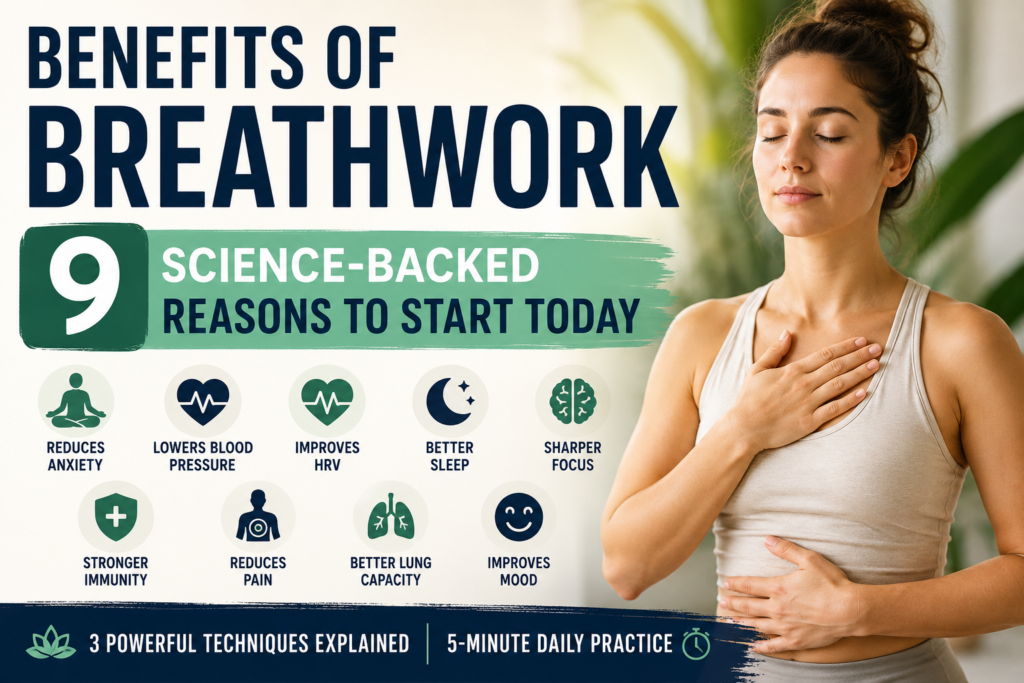
Each benefit below has peer-reviewed evidence behind it. I’ve included the most robust study or institutional source I know of for each.
1. Reduced anxiety within minutes
A 2023 Stanford study published in Cell Reports Medicine (Huberman Lab group) compared cyclic sighing, box breathing, and mindfulness meditation for mood and anxiety. Cyclic sighing produced the largest reduction in anxiety, measurable in a single 5-minute session. Two short inhales through the nose followed by an extended exhale through the mouth. This is the research behind the Huberman Lab protocols.
2. Lower blood pressure
A 2021 NIH-indexed trial showed just six weeks of daily diaphragmatic breathing dropped systolic blood pressure by 9 mmHg. An effect size comparable to many antihypertensive medications.
3. Improved heart rate variability (HRV)
HRV is one of the best biomarkers of autonomic nervous system health. Higher HRV means more resilience. Paced breathing at roughly 6 breaths per minute produces the largest, fastest HRV improvement of any non-pharmacological intervention.
4. Better sleep
4-7-8 breathing done for 4 rounds before bed measurably shortens sleep onset time in clinical studies. The long exhale activates the parasympathetic system. This is one of the benefits of breathing exercises you feel the first night you try.
5. Sharper focus and working memory
A 2018 Psychophysiology paper demonstrated improved sustained attention and working memory after 20-minute breathwork sessions. The effect is partly mediated by nasal nitric oxide release.
6. Stronger immune function
A 2014 PNAS study on Wim Hof practitioners showed voluntary modulation of the innate immune response, previously thought impossible. Practitioners produced fewer inflammatory cytokines when injected with bacterial endotoxin.
7. Reduced chronic pain perception
The British Journal of Sports Medicine and multiple pain-management reviews have documented slow-breathing protocols reducing chronic pain intensity by 20 to 40% through vagal tone, inflammation reduction, and central pain modulation.
8. Increased lung capacity and efficiency
Pranayama-style practice measurably increases tidal volume and vital capacity within 8 to 12 weeks. Nasal-only breathing during exercise has been shown to improve oxygen uptake efficiency without increasing perceived exertion. This is one of the pranayama benefits that matters most for athletes and active people.
9. Measurable mood improvement
Multiple trials now show daily 5-minute breathwork protocols produce mood improvements comparable to short meditation courses, with faster onset. This is one of the pranayama benefits that gets practitioners hooked on day one.
Box Breathing, Nadi Shodhana, and 4-7-8 Explained
These three cover 90% of what a beginner needs. Learn one at a time. Give each a week before moving on.
Box breathing (Sama Vritti)
Inhale for 4, hold for 4, exhale for 4, hold for 4. Used by US Navy SEALs and the British military for state management under stress. Best for: focus, pre-meeting calm, acute stress. When to avoid: pregnancy (avoid breath retention) and uncontrolled hypertension.
Nadi Shodhana (alternate nostril breathing)
Close right nostril with thumb, inhale left. Close left, release right, exhale right. Inhale right, close, exhale left. That’s one round. Do 5 to 10 rounds. Best for: balancing energy, calming scattered mind, mental clarity. When to avoid: blocked nose or acute sinus issues.
4-7-8 breathing
Inhale through nose for 4, hold for 7, exhale through mouth for 8 (make a gentle whoosh). Four rounds, twice a day. Developed by Dr Andrew Weil from traditional pranayama. Best for: sleep, anxiety, acute panic. When to avoid: pregnancy and anyone who feels lightheaded (shorten counts).
Two other techniques worth knowing
Wim Hof method (30 deep breaths followed by retention on empty) is stimulating, not calming. Useful in the morning or before cold exposure. Cyclic sighing from the Stanford study is the simplest stress-relief breath available: double inhale through nose, long exhale through mouth, repeat for 5 minutes.
Breathwork for Anxiety Specifically
Anxiety is a breathing pattern before it’s a thought pattern. Anxious people almost always breathe shallow and high, through the mouth, at 18 to 25 breaths per minute (normal resting is 12 to 16). Fix the breathing and the mental symptoms reduce, often before you’ve even identified what you’re anxious about.
The protocol I teach for breathwork for anxiety
- Week 1: Diaphragmatic breathing, hand on belly, 5 minutes twice a day. Nothing else.
- Week 2 to 3: Add 4-7-8 before bed, 4 rounds.
- Week 4: Introduce nadi shodhana in the morning.
- Week 5+: Cyclic sighing whenever anxious, 3 to 5 minutes. Works faster than most medication.
A woman from Belfast started this protocol last year after years of panic attacks. By week six, her panic frequency had halved. By week twelve, she was off her short-acting medication with her GP’s agreement. That’s not everyone’s experience, but it happens often enough that I start every anxious student with the breath before anything else. Breathwork for anxiety is the single most effective entry point I’ve found in 20 years of teaching.
Breathwork vs Meditation: Key Differences
They overlap but aren’t the same. Meditation is primarily mental training: attention, awareness, non-reactivity. Breathwork is primarily physiological intervention: you’re changing CO2, oxygen, vagal tone, autonomic state.
| Breathwork | Meditation | |
|---|---|---|
| Primary target | Nervous system | Attention / mind |
| Speed of effect | Minutes | Weeks to months |
| Ease for beginners | High: structured | Moderate: mind wanders |
| Acute anxiety | Excellent | Limited |
| Long-term resilience | Good | Excellent |
| Time needed | 5 to 10 minutes | 10 to 30 minutes |
| Spiritual dimension | Optional | Optional but traditional |
The practical answer: use breathwork for state change (today) and meditation for trait change (long-term). They’re complementary, not competing. Read more on the mind-training side in my guide to the benefits of meditation, and see how breath integrates into full practice in yoga for stress relief.
How to Start: 5-Minute Daily Practice
Experience the benefits of breathing exercises on day one
Every beginner at my Omagh studio gets this exact protocol on their first day. It takes five minutes and works. You don’t need to understand the science behind it. You just need to follow the steps and notice what happens in your body over those five minutes.
- Sit comfortably. Chair, cushion, bed, doesn’t matter. Back upright.
- Exhale fully through the mouth. Empty the lungs.
- Inhale through the nose for 4 counts. Let the belly rise first, then the chest.
- Hold for 4 counts.
- Exhale through the nose for 6 counts. Slow, controlled.
- Repeat for 5 minutes. Count on your fingers if you lose track.
The only rule: if you feel lightheaded, breathless, or dizzy at any point, return to normal breathing. You’re not earning bonus points for intensity. Consistency beats depth.
Do this once a day for 14 days. By day 14 you’ll have a reliable baseline and can branch into the techniques above. A student from Omagh told me recently this was the only self-care practice she’d ever kept up for a full year, because it was short enough to actually do on bad days. That’s the real power behind the benefits of breathing exercises: the barrier to entry is so low that you actually do it.
Frequently Asked Questions About the Benefits of Breathwork
How long does breathwork take to work?
Acute effects (lower heart rate, reduced anxiety, clearer head) can appear within 2 to 5 minutes of practice. Baseline changes (lower resting blood pressure, better sleep onset, higher HRV) typically take 4 to 8 weeks of daily 5 to 10 minute practice. Speed is one of the main benefits of breathwork over meditation.
Is breathwork dangerous?
Most slow-breathing and box-breathing practices are safe for the general population. Intense practices (Wim Hof, holotropic) should be avoided in pregnancy, uncontrolled hypertension, active cardiovascular disease, epilepsy, or panic disorder unless under supervision. Never practise breath retention in water.
Can breathwork replace therapy or medication?
No. Breathwork is a complement to mental health care, not a replacement. For diagnosed anxiety disorders, panic disorder, or depression, work with a GP or qualified therapist. Use breathwork alongside professional care, not instead of it.
What are the best breathwork benefits for beginners?
The breathwork benefits beginners notice first are better sleep (from 4-7-8), lower day-to-day anxiety (from diaphragmatic breathing), and sharper focus (from box breathing). Start with simple diaphragmatic breathing for week one. Add box breathing in week two. Add 4-7-8 for sleep in week three. Resist starting with intense techniques like Wim Hof until you have 4 to 6 weeks of gentle practice behind you.
How often should I do breathwork?
Daily beats occasionally. Five minutes every day produces far more change than 30 minutes once a week. Morning is ideal for calming techniques; evening for sleep-focused practices; anytime for anxiety management.
Can breathwork help with asthma?
Evidence suggests techniques like Buteyko and slow nasal breathing can reduce asthma symptoms and reliever inhaler use. Always work with your GP or respiratory consultant. Don’t stop prescribed medication. A 2020 Cochrane review found breathing exercises are a useful adjunct to standard asthma care.
Is mouth breathing or nose breathing better?
Nose breathing, almost always. Nasal breathing filters, warms, and humidifies air, produces nitric oxide (which improves oxygen uptake), and triggers parasympathetic activation. Mouth breathing is useful only during heavy exertion or specific techniques like 4-7-8 exhales.
What are the main pranayama benefits compared to modern breathwork?
The pranayama benefits are largely the same as modern breathwork because modern breathwork is built on pranayama techniques. The difference is context. Pranayama traditionally includes spiritual and energetic dimensions (prana, nadis, chakras) while modern breathwork focuses on measurable physiological outcomes. The breathing mechanics and the physical results overlap almost completely.
Does breathwork produce emotional release?
Sometimes, especially with deeper or longer practices. Long-held tension or emotion can surface during sustained breathing. This is usually helpful but can be overwhelming. Work with a qualified facilitator for intense breathwork if you have a trauma history.
The Bottom Line on the Benefits of Breathwork
The benefits of breathwork are evidence-backed, immediate, and available to anyone. No equipment, no subscription, no studio required. Five minutes a day for two weeks is enough to feel the difference. Eight weeks shifts your baseline.
Pick one technique from this guide, practise it daily for 14 days, and notice what changes. If you want a deeper introduction to pranayama in person, I cover full breath traditions in my Yoga Alliance accredited teacher training in Omagh.
About the author: Brídín Mullan is a Yoga Alliance registered teacher with 15,000+ contact hours of teaching experience. She founded Orba Yoga Spa in Omagh in 2015 and leads Yoga Alliance accredited 200-hour teacher training with dedicated modules on pranayama and breathwork. She trained in Thailand in 2011 and has nearly 20 years of personal practice.